Welcome to Northwestern Physics and Astronomy
Faculty and Research
Our research employs an broad range of theoretical and experimental approaches to understand the fundamental nature of the universe.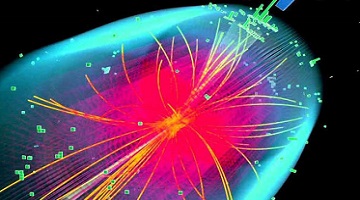
Seminars and Colloquia
See our weekly seminars and colloquia throughout the academic year.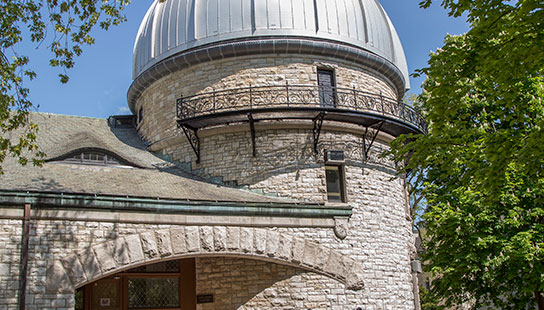
Dearborn Observatory
Visitors are invited to tour the Observatory every Friday night.
News and Events
Observing at Dearborn Observatory
The Dearborn Observatory is open on Friday evenings for walk-in tours at 10:00 PM for public observing with the historic 18.5 inch refracting telescope.
Events
Apr
26
2024
Colloquium: Shih-Chieh Hsu: "Unravelling Dark Universe with Artif...
4:00 PM - 5:00 PM, Evanston
Compelling experimental evidence strongly supports searches for new particles predicted by theories Beyond the Standard Model (BSM). Su...
Apr
29
2024
HEP Seminar: Sophie Middleton: "Searching for Muon Charged Lepton...
4:00 PM - 5:00 PM, Evanston
It is well established that quarks and neutral leptons (neutrinos) exhibit flavor violation. Observation of neutrino oscillation implie...
Apr
30
2024
Astrophysics Seminar:Scott Ransom "Neutron Star Masses: The Bigge...
11:00 AM - 12:00 PM, Evanston
The central densities of neutron stars are the highest known in the Universe, so mass and radius measurements of pulsars give us unique...