Physics is the broadest of the sciences, and more than any other seeks to explain the natural world in the most universal manner possible. Physicists emphasize basic knowledge, looking for the hidden symmetries that underlie the natural world, and try to express them in the most universal terms possible. The breadth of problems studied in modern physics and astronomy is great. Our department has active research programs in areas ranging from theoretical astrophysics and observational astronomy to complex systems, condensed matter physics, atomic, molecular and optical physics, and nuclear and particle physics.
Prof. Jens Koch Hosts Middle-School Physics Adventure
Earlier in May, 20 middle-school students visited Northwestern as part of the after-school Science Club run by Science in Society. They joined Prof. Jens Koch and a group of our graduate students to learn about extremely low temperatures in a "physics adventure." Graduate student Bill Gannon told Science in Society that, “I think the thing that we hope the kids will get out of the trip is that science is not just your teacher, who you may or may not like very much, writing on the blackboard. Science is something that’s happening all the time and it’s fun and it’s not just something that’s abstract.” Read the full story from Science in Society, or visit their facebook page for more pictures.
Prof. Sara Solla and the the BRAIN Initiative
Neurotechnologies) Initiative announced by President Obama on April 2, 2013. Professor Solla, who represents Northwestern University, is a theoretical physicist working in computational and theoretical neuroscience. Her research focuses on constructing mathematical models to understand how networks of neurons acquire, store, and process information. Current projects include the decoding of neural signal from primary motor cortex for the guidance of prosthetic limbs, and the encoding of sensory signals by neurons at the base of rats' whiskers.
|
MINERvA Publishes First Results
Laura Fields Cheryl Patrick New results have been released from the MINERvA collaboration, which includes postdoc Laura Fields and graduate student Cheryl Patrick. MINERvA observes neutrino-nucleus interactions in order to better understand the behavior of protons and neutrons in the nucleus. Both Fields and Patrick work with Prof. Heidi Schellman. Read more at Fermilab Today.
The Search for Dark Matter
He spoke with the Northwestern Newscenter recently about his research. Read the full article here.
Chaos Turns Fifty
Read the original article here. |
|
|
|


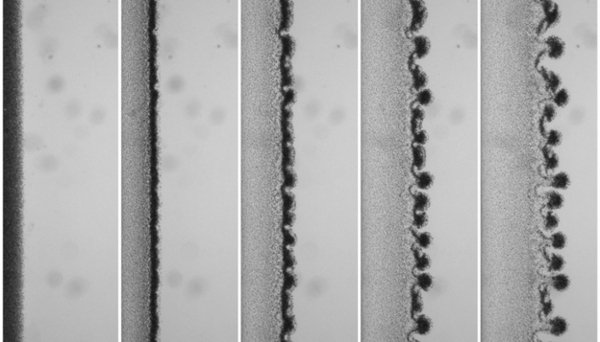
Fifty years ago Edward Lorenz revealed deterministic predictability to be an illusion and gave birth to a field that still thrives. In an invited piece featured as the cover article of Physics Today,